
Why Librarians Are the Right Leaders for AI Literacy
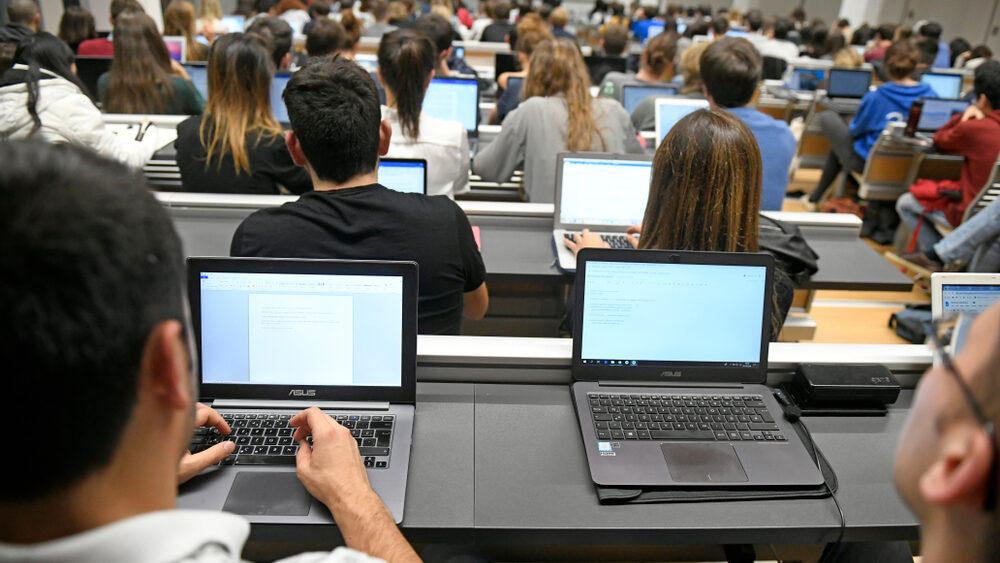
A freshman walks into her first college seminar having used ChatGPT to outline every essay since ninth grade. Her roommate down the hall has never opened a generative AI tool and doesn’t trust its output. Neither one is using AI effectively, but who can blame them: neither has had real instruction in how to use AI well.
Librarians have taught students how to evaluate a source for decades. AI is just the newest thing to evaluate.
Students Are Learning AI Unevenly, If At All
Whether a student picked up real skill with generative AI usually comes down to the high school they attended. The people who teach it and the policies that govern it differ at every school. Neither is consistent enough to guarantee much of anything.
Even the best-case version of that doesn’t solve the problem. A student could attend a school where instructors taught AI well and offered support. They could still leave with the wrong idea about their own ability. Feeling confident about a skill and actually having it are different things. Generative AI can make that gap easy to miss.
That gap isn’t new. Research on the jump from high school to college found the same mismatch between self-perception and actual skill before generative AI existed: students arrived on campus believing they were better researchers than they were (Correll, 2019).
Consequences show up later. When a student seems prepared, professors assumes they are, and the skill gap may never be tested or corrected. From there, some students may lean on AI completely, letting it handle a task from start to finish because nothing has ever pushed back on that habit. Others may end up distrusting it altogether and avoid building skills development their employers will expect. Both strategies eventually limit students’ likelihood for success in modern learning and professional contexts.
The AI Dilemma
Every student has a decision in front of them, whether they think of it that way or not: adopt AI and let the tool do the thinking, avoid it like the plague, or approach it like any other information resource, used while maintaining intellectual agency.
AI Literacy Is Information Literacy
Information literacy is essential in academic libraries for guiding users to reliable information. AI literacy is no different. Librarians have taught information literacy for years, and AI literacy is mostly that same work.
The ACRL Framework already covers most of it. The definition of “authoritative content” as constructed and contextual prompts a student to ask why information should be trusted. That is a valuable skill whether the information source is a journal article or a chatbot’s answer. Additionally, the framework’s approach to research as inquiry treats searching as a back-and-forth process. This type of iterative approach is effective regardless of the information resource used for research, but especially when using a generative AI tool (ACRL, 2016).
A 2024 piece in Reference & User Services Quarterly describes how the rise of generative AI and ChatGPT has revived the scholarly enthusiasm of reinspecting information literacy competency standards and frameworks in the age of artificial intelligence (Wu, 2024).
Librarians Are Already Building the Playbook
There’s no single agreed-upon standard for teaching AI literacy yet, but there are a handful of campus programs built by enthusiastic, early adopters. Stanford’s Teaching Commons has a guide for faculty, Barnard’s Center for Engaged Pedagogy built one for generative AI specifically, and Auburn’s Biggio Center offers similar support. Bronx Community College built an AI workshop LibGuide other librarians can copy directly. Elon University and the American Association of Colleges and Universities publish the Student Guide to Artificial Intelligence, now endorsed by the American Library Association, and Harvard’s metaLAB runs the AI Pedagogy Project. Librarians show up across most of this work because it’s the job they’ve always done.
Where Infobase’s AI Video Collection Fits In
It is only natural for librarians, who have held the mantle of information literacy for generations, to step into core leadership roles for developing AI literacy at their institutions. But AI literacy goes far beyond teaching students to operate the latest version of Claude.ai.
That’s the thinking behind our enhanced AI Video Collection. At Infobase, we treat AI literacy as a critical competency, irrespective of the trending AI tool this month. Learning to prompt a chatbot is a narrow skill. Learning to use AI responsibly is instead the focus, in ways that hold up against ethical standards, connect to real career paths, account for its effect on society, and support a faculty member’s own teaching practice.
About the Collection
The enhanced AI Video Collection is structured around five themes: Foundations, Career Applications, Ethical Implications, Societal Impact, and Teaching Practices & Professional Development. All five are built around the same measure of success. AI supplies efficiency. A person still has to supply the agency, the judgment call on whether an output can be trusted, and the aesthetic sense of whether the output is any good. A student who gains efficiency but loses judgment is the outcome the collection aims to prevent.
Content comes from TED, MIT Sloan Management Review, and Insights University, along with interviews commissioned specifically for this collection. Boston College’s Sam Ransbotham, a professor of business analytics who co-hosts the Me, Myself, and AI podcast, appears alongside colleagues Chris Glass and Sasha Tomic, whose research covers higher education leadership and applied analytics.
Titles such as, “Can AI make us more human?” and “How to stop AI from killing your critical thinking” inform the collection alongside the technical foundations. “I’ll probably lose my job to AI. Here’s why that’s OK” and “AI and the paradox of self-replacing workers” take on labor displacement with directness, with the claim that AI can make human work more meaningful over time.
The collection is built to serve two audiences at once: faculty who need professional development resources before they can teach AI with any confidence, and students across disciplines, from English Composition to Nursing to Political Science, who need curriculum-aligned content that doesn’t require their instructor to become an AI expert first.
AI is evolving rapidly every day. But it’s the role of the library to help support the durable strategies faculty and students can employ, regardless of the tool of the day.
Explore the AI Video Collection for Your Institution
Infobase’s AI Video Collection is designed to be the future-forward collection to support AI literacy at your institution. Interested in exploring what the AI Video Collection can do? Schedule a conversation with a member of our team.
