
Learning in the Modern Age: Why Students Need a Managed, Structured Flow of Information
Imagine this: A learner begins a research project on the Amazon rainforest. They open a laptop, and an hour later, they’re watching a video about a capybara befriending a cat. Fifteen tabs are open, there’s a half-written sentence, and a look of total frustration. Sound familiar?
The endless ocean of information we call the internet was supposed to make learning easier. Yet for many students and library patrons, it often creates confusion rather than clarity. Why does it so often feel like it’s doing the opposite?
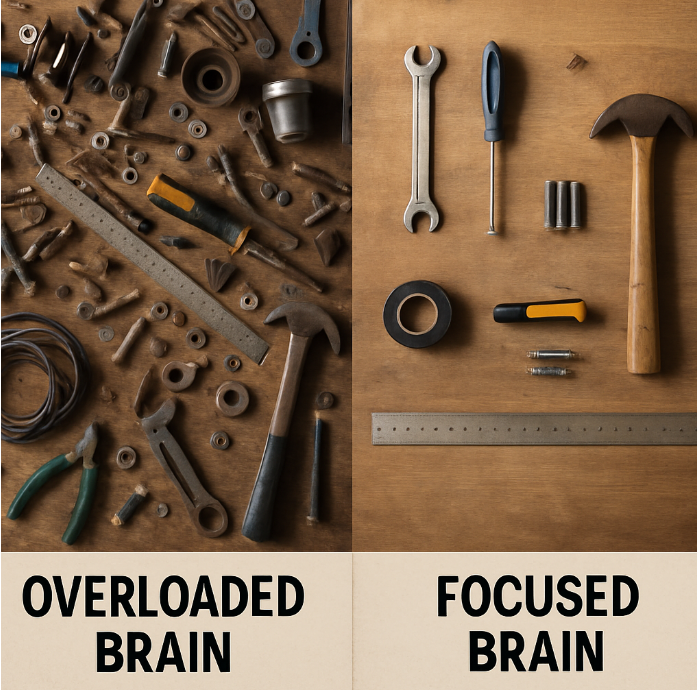
To understand this, think about a time you felt completely overwhelmed—like assembling furniture with a messy pile of parts and confusing instructions. Our brains work similarly. Think of your active, conscious mind as a small workbench; it can only hold a few tools and concepts at one time. This limited space is where we do the actual work of learning—connecting new ideas to what we already know.
If you dump the entire toolbox onto that small bench at once, you can’t build anything. You just get paralyzed by the mess. This is precisely what happens when learners are left to navigate unfiltered, unstructured information environments on their own. Their mental workbench becomes cluttered with facts, ads, opinion pieces, and distractions—leaving little room for understanding to take shape.
Cognitive scientists call this overwhelming pressure cognitive load. When the load is too high, the brain can’t effectively process information. Improving focus and retention isn’t about finding more information—it’s about managing how information is introduced, organized, and connected. And when that structure is built into a unified digital environment, every resource within it becomes more powerful.
Guided Tour vs. Endless Maze: Why the Path Matters as Much as the Content
Think about visiting a vast museum. In one scenario, you’re dropped into the middle with no map. In another, a curator gives you a guided tour, explaining how early pieces influence later ones and how each exhibit fits into a larger story. Both scenarios offer access to the same artifacts—but only one leads to real understanding.
This is the essential difference between unstructured and structured learning.
On the open web, learners are forced to do two demanding jobs at once: find relevant information and determine how it fits together. The result is often cognitive overload, fragmented notes, and frustration.
In contrast, a structured path—shaped by expert curation and intentional sequencing—reduces friction. Information unfolds logically, allowing learners to focus on comprehension rather than navigation. And when learners aren’t burdened with organizing chaos, they engage more deeply. Engagement is where learning sticks.
Building Knowledge That Lasts Requires More Than Access
Learning follows the same rules as construction. You start with a solid foundation before putting up the walls. Each piece relies on what came before it.
Yet online research frequently reverses this process. A quick search can lead a student directly to advanced analysis before foundational knowledge is established. It’s the educational equivalent of trying to install the kitchen sink before the foundation is poured. This isn’t a failure of motivation—it’s a failure of structure.
When resources are presented in logical sequence—foundation first, complexity second—learners gain confidence alongside comprehension.
For libraries and educators, the challenge is no longer access to information. It’s designing systems that support progression at scale.
From Chaos to Clarity: Embedding Structure Into the Research Experience
Advice like “define the question” or “start with a trusted source” is valuable—but it places the burden of structure entirely on the learner. The most effective learning environments embed that structure directly into the research experience.
This is where integrated learning platforms matter.
Rather than asking users to jump between disconnected databases, websites, and tools, a unified platform can bring curated content, research guidance, and skill-building tools into one cohesive environment. Within Infobase’s integrated platform, for instance, learners can move from topic overviews to in-depth analysis without losing context. Each curated content collection lives within the same structured environment—reinforcing shared workflows, consistent navigation, and connected learning pathways.
As libraries expand collections within that unified ecosystem, they aren’t adding complexity. They’re strengthening continuity.
Learners still explore—but within a framework designed to support understanding instead of overwhelm.
Why Integration Changes the Experience
Historically, libraries have provided exceptional digital content—often distributed across multiple vendor platforms, each with its own interface and workflow. Even highly motivated users can struggle when every resource requires them to relearn how to search, filter, and synthesize.
An integrated platform changes that dynamic. Because when additional databases and collections operate within the same learning architecture, the experience scales without increasing cognitive load.
When video, reference materials, primary sources, and research tools live within a single, intuitive interface, learners can move seamlessly across formats. Connections between disciplines and topics become more visible. Momentum is preserved. Cognitive load is reduced.
For libraries, a unified and expandable platform offers measurable benefits:
-
Stronger engagement and sustained usage as collections reinforce one another
-
Clearer demonstration of impact on learning outcomes across disciplines
-
A scalable digital ecosystem that grows without fragmenting the user experience
From Content Access to Learning Architecture
The frustration learners experience online isn’t a personal failure—it’s a systems issue. When libraries invest in structured, integrated research environments—and intentionally build within them—they shift from simply providing content to designing scalable learning architecture.
That shift matters.
In a time when engagement, outcomes, and return on investment are under increasing scrutiny, platforms that unify trusted content, scaffolded learning pathways, and research tools offer a strategic advantage. They reduce friction for learners, strengthen information literacy skills, and help libraries clearly demonstrate their value within the academic ecosystem.
Moving beyond access toward intentional learning design isn’t about limiting exploration—it’s about enabling deeper understanding.
And that’s where structure makes all the difference.
Explore the Potential of Your Information Ecosystem
For libraries seeking to move beyond access and toward measurable learning impact, the question isn’t simply what to add next—it’s where those additions live.
When new collections are introduced within a cohesive, structured platform, they don’t increase complexity. They strengthen the learning environment itself.
Our team would be glad to explore how expanding within an integrated ecosystem can support your institution’s goals—today and over time.
Schedule a conversation to explore what building within a unified learning architecture could mean for your community.
